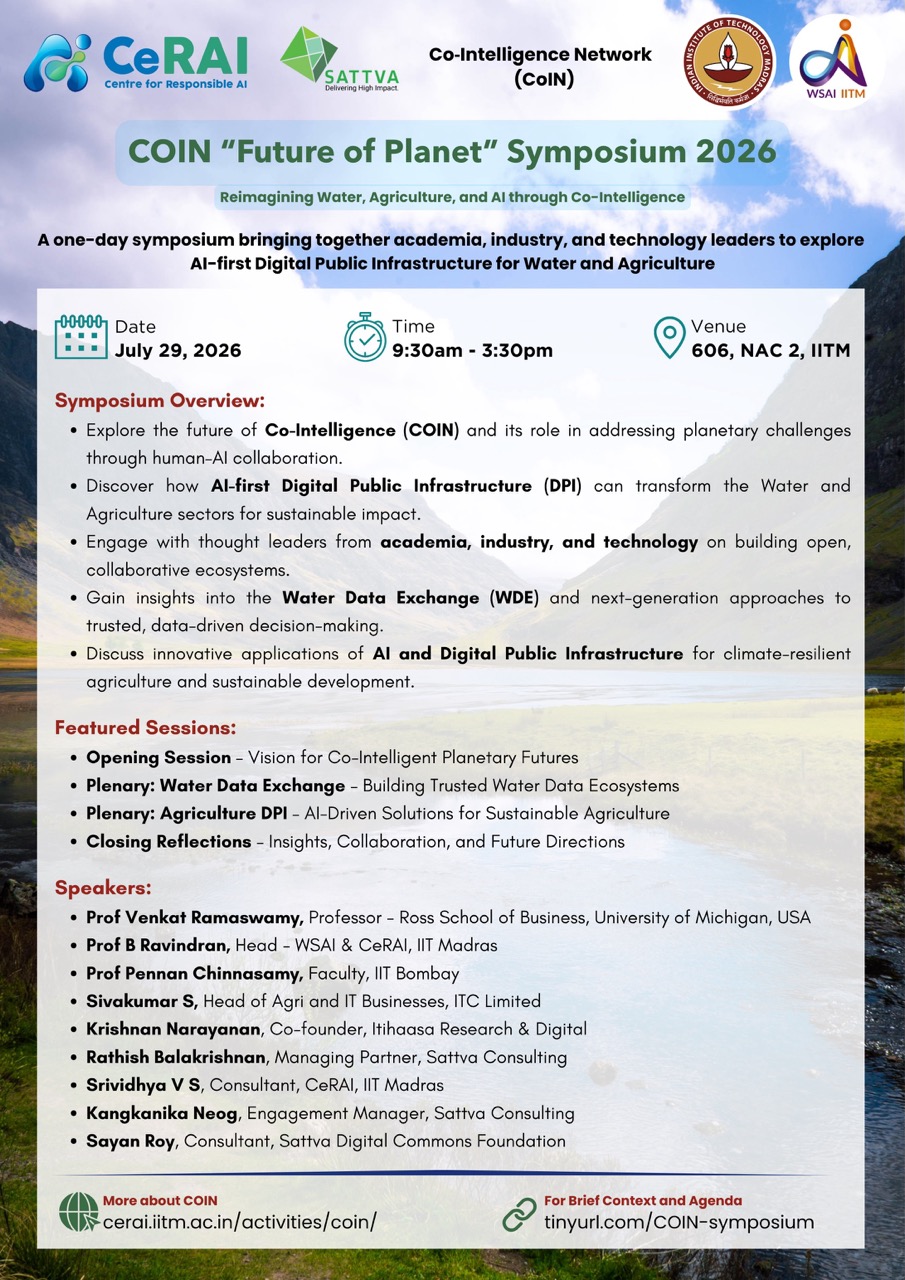
COIN "Future of Planet" Symposium 2026
Date: 29 July 2026
Venue: Indian Institute of Technology Madras
Co-organisers: Centre for Responsible AI (CeRAI), IIT Madras and Sattva Digital Commons Foundation
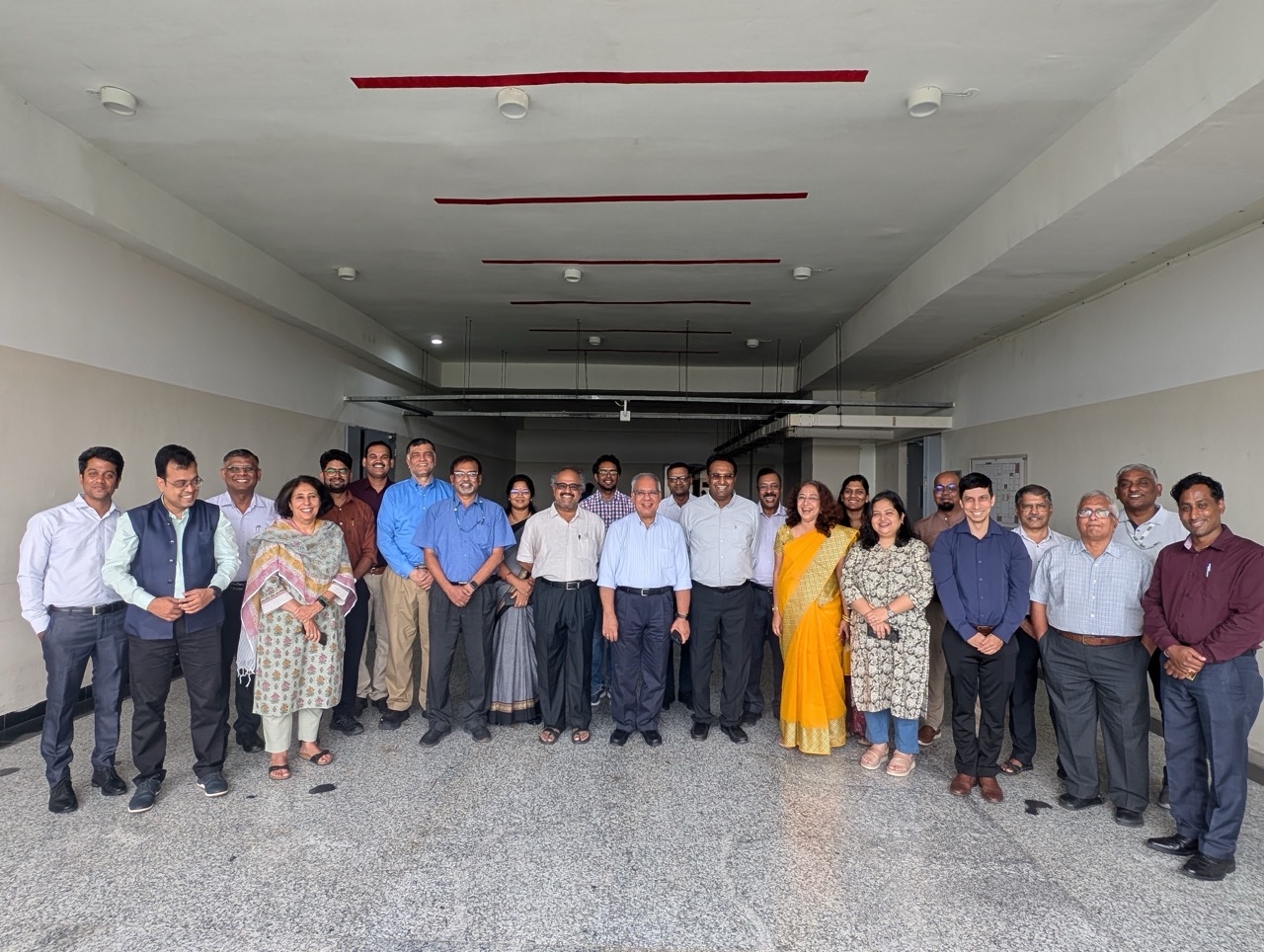
The COIN "Future of Planet" Symposium 2026 brought together over thirty leaders from academia, government, industry, philanthropy, and civil society to explore how humans and AI can co-create self-sustaining ecosystems of life and value. The discussions focused on two sectors critical to planetary resilience: the Water Data Exchange (WDE) and Agriculture Digital Public Infrastructure.
The inaugural session featured Prof. B. Ravindran, Head, WSAI and CeRAI, IIT Madras, Mr. Krishnan Narayanan, Co-founder, Itihaasa Research and Digital, Mr. Sivakumar S, Head of Agri and IT Businesses, ITC Limited, Prof. Venkat Ramaswamy, Ross School of Business, University of Michigan, Mr. Rathish Balakrishnan, Managing Partner, Sattva Consulting, Prof. Pennan Chinnasamy, RuDRA Lab and VS Srividhya, Consultant, Centre for Responsible AI. During the symposium, Prof. B. Ravindran formally released Co-Creating the Future with AI, authored by Prof. Venkat Ramaswamy, Kerimcan Ozcan and Mr. Krishnan Narayanan, and published by Palgrave Macmillan in 2026. This was followed by the release of an article exploring the ideas behind Co-Intelligence and its potential to shape the future of AI, society and the planet. It was co-authored by Srividhya V S and Prof. G.N. Hariharan. Read more here.
Participants examined the vision for an AI-first, federated, and trusted data-sharing infrastructure for water, and explored agriculture DPI including voice-first farmer advisory, vernacular AI, satellite intelligence, and field-grounded implementations such as BharatVistaar and FarmVaidya AI. Key themes that emerged included the need to move from computational intelligence toward ecological intelligence, designing for learning velocity and not just adoption, the role of voice-first and vernacular AI in inclusion, the shift from vertical point solutions to open, protocol-based infrastructure, dynamic trust-building through multi-source triangulation and feedback loops, and the importance of human orchestration with explicit incentives for sustained data contribution. Stakeholders participated in a tour of the AI4Bharat Lab powering a crucial language portion of the tech stack. To conclude, institutional commitments were made to transition from a one-off symposium to a permanent, active and sustained cohort of cross-sector practitioners.