CeRAI Research Focus

Frugal AI

A Frugal AI Framework for India: Responsible and Right-sized AI

AI that meets a fixed requirement with minimal resources, while keeping a verified margin, robustness and responsible governance. Built to maximise social value per rupee and per joule.

White Paper · November 2026 · Centre for Responsible AI (CeRAI), IIT Madras

Executive summary

The idea in brief

The problem

Two insufficient views

India's AI debate swings between replicating the compute-heavy foundation-model programmes of the US or China, or staying a downstream adopter of foreign AI. Neither serves a country that must deliver AI to a very large, diverse population across uneven infrastructure and within constrained budgets.

The third path

Responsible Frugal AI is right-sized AI

Fix the functional requirement first, ask whether AI is needed at all, then choose the smallest sufficient model. Smaller, better-scoped systems cut compute, hardware and energy use, and are easier to govern.

Why Frugal

Resource-imbalanced, not resource-poor

Compute, connectivity, skills and capital exist but are unevenly distributed, and access to compute is the major constraint. Frugal principles are the most viable route to population-scale AI and fit naturally with India's digital public infrastructure.

  • 4 frugality dimensions
  • 7 levers across the AI lifecycle
  • 9 principles
  • 7-point adoption checklist
  • 11 policy statements

Video series

Frugal AI in under a minute

Prof. Balaraman Ravindran on why India should build right-sized AI. Each short is paired with the passages of the white paper it draws on.

Part 1

Don't compete on their stage. Build your own.

Should India try to beat the biggest AI companies at their own game? Prof. Balaraman Ravindran suggests a better question: what problems do we need AI to solve? India doesn't have enough doctors, but it does have a huge network of ASHA workers. What if AI helped them make medically sound decisions in the field?

From the paper

India's AI debate often swings between two insufficient views: replicating the compute-intensive, capital-heavy foundation-model programmes similar to that of the United States or China, or remaining a downstream adopter of foreign AI with localised interfaces and safeguards.

Executive Summary

Frugal AI questions are not just about “How can India build the largest possible model?” but “For any AI tool-based solution, what mix of data, models, hardware, and public infrastructure will maximise reliable social value per rupee and per joule?”

Section IV, India's AI Debate

Principles in play

Part 2

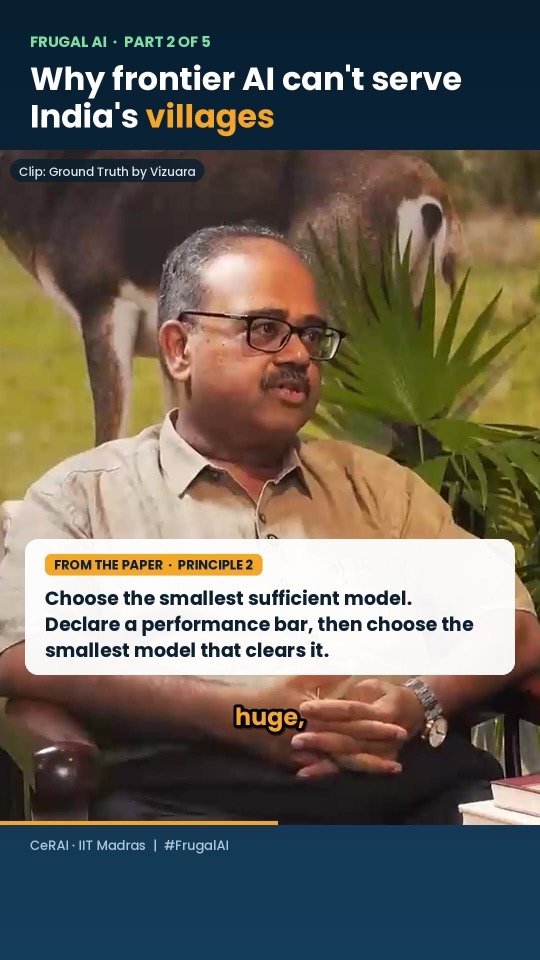
Why frontier AI can't serve India's villages

Nobody is bankrolling frontier-scale AI for every village query. The query volume is huge, the cloud can throttle you, and the compute bill keeps growing. Prof. Ravindran explains why many headline AI advances become impractical at village scale.

From the paper

High-end AI hardware is scarce and costly, and the binding bottleneck is computing access, not ambition.

Section IV, India's AI Debate

A rural agricultural advisory platform illustrates this hybrid architecture well: it can use a traditional, low-compute decision tree to accurately diagnose a crop disease from structured soil data, while a small, locally hosted language model translates that diagnostic result into a fluent, conversational Tamil interface.

Section VI.c, Model Frugality

Thus, the “Frontier of AI” need not be the largest model; it can also be the smallest or right-sized model that does the job, as envisaged by Frugal AI approaches.

Section III.v, Frugal AI: Why now?

Principles in play

Part 3

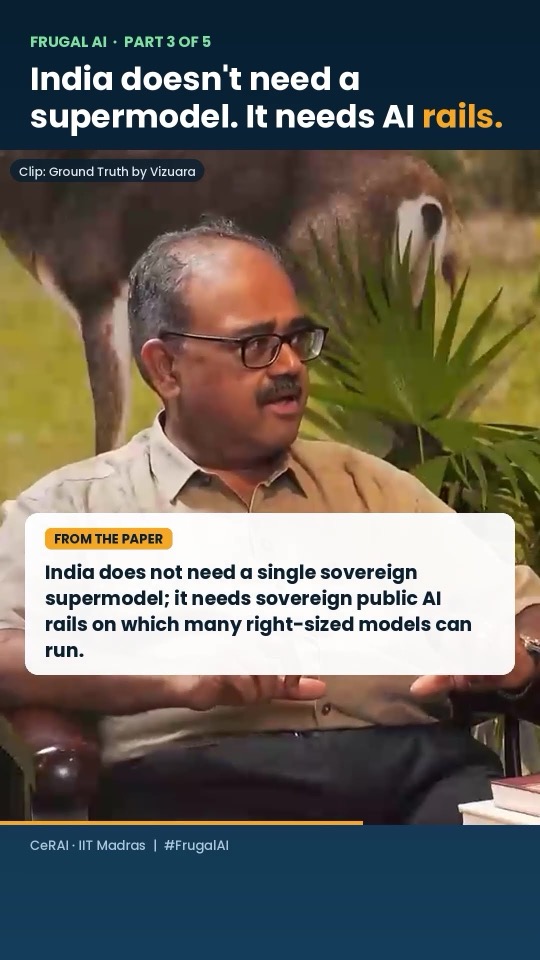
India doesn't need a supermodel. It needs AI rails.

Small language models, CNN-based vision models, distilled and edge models, all purpose-built. Prof. Ravindran describes the shared “AI rails” that any of these frugal models can plug into.

From the paper

India does not need a single sovereign supermodel; it needs sovereign public AI rails on which many right-sized models can run.

Section VI.d, Operational Frugality

A DPI-style AI stack reduces duplication, lowers entry barriers, improves accountability, and makes it possible to deliver trustworthy AI as a public utility rather than as a collection of costly, siloed products.

Section VI.d, Operational Frugality

Principles in play

Part 4

Frugal in compute, data, model and communication

Frugal AI isn't cheap AI. It means meeting the requirement without waste. Prof. Balaraman Ravindran lists frugality in compute, data, model size and communication, for AI that runs where connectivity is scarce.

From the paper

Frugality in AI should be understood as adequacy without waste. It does not always mean inferior or cheaper AI systems. Rather, it demands disciplined and rigorous frugal engineering: selecting architectures, datasets, inference pathways, interfaces, and governance mechanisms that fit the purpose and match the task.

Section VII, CeRAI's principles for Frugal AI

Responsible Frugal AI is right-sized AI. It meets a fixed functional requirement with minimal resources, while keeping a verified margin, robustness and responsible governance.

Executive Summary

CeRAI applies frugality across four dimensions (data, compute, model and operations) through seven levers (data foundation, architecture choice, training efficiency, compression, adaptation, retrieval grounding, and serving and silicon) that span the AI lifecycle, each with practices and measures.

Executive Summary

Principles in play

Part 5

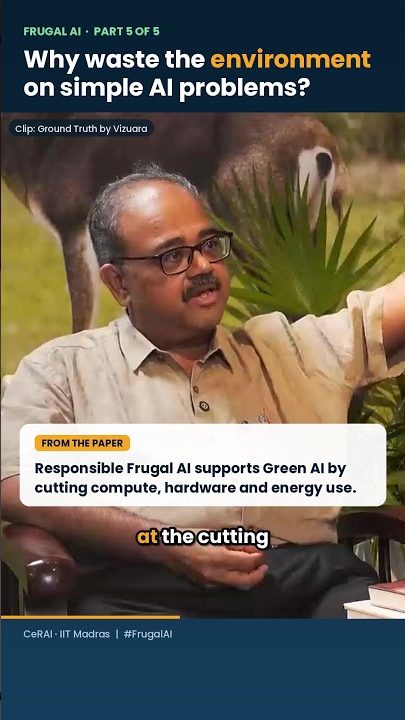
Why waste the environment on simple problems?

If India builds a robust frugal AI stack, people in Africa and the US will want to use it too. Why waste the environment building giant models for simple problems? Prof. Balaraman Ravindran on why AI diffusion at India's scale needs a different set of solutions.

From the paper

A Frugal AI system contributes to “Green AI” outcomes because it provides evidence-based pathways to use less compute, hardware, and energy. It supports “Responsible AI” because any smaller, narrower, and better-scoped systems are often easier to sustain, interpret and govern.

Section II, Frugal AI: A Broader Responsible AI Strategy for India

AI is currently shaped by a default that the largest model is the right starting point. That default is expensive in energy, capital and institutional capability, and its costs are not distributed equally.

Section X, The Policy Statements

Efficiency techniques alone do not deliver frugality. The paper therefore combines efficiency techniques with a reviewable limit on total use for publicly funded AI.

Section X, The Policy Statements

Principles in play

Clips from Ground Truth Ep 2 by Vizuara.

The framework

Four dimensions of frugality

CeRAI applies frugality across four resources where it can be engineered. Each comes with practices and measures, so frugality can be checked rather than claimed.

Data frugality

Use the least data that meets the requirement, and make that data clean, documented and well chosen. This is not using less data than a model needs: small models trained on highly curated data can outperform massive models trained on unfiltered crawls.

Measured by

  • Dataset size and labelling effort per task
  • Overlap between training and test data
  • Per-group accuracy
  • Share of data spent on underserved languages

Compute frugality

Meet the requirement with less training and inference compute, and measure that use objectively. Start from existing checkpoints, use lower precision where the model still clears its bar, and budget reasoning steps to the difficulty of each query.

Measured by

  • Energy and carbon per useful outcome
  • Total GPU-hours, including failed runs
  • Hardware utilisation
  • Inference compute per query or task

Model frugality

Choose the smallest model, or smallest set of trained parameters, that meets the requirement, and verify it against that requirement. The preferred design is the point on the Pareto front that clears the declared bar at minimum compute and memory.

Measured by

  • Parameters and memory per task
  • Accuracy on targeted tests, with uncertainty
  • Share of requests escalated to a larger model

Operations frugality

Serve at low cost per useful outcome: size the model to each task, route queries sensibly and use hardware well. Treat AI as infrastructure, with shared public rails, non-AI fallbacks and human handover for essential services.

Measured by

  • Utilisation and idle capacity
  • Cost per user served
  • Share of services with a non-AI fallback
  • Incident rates

Seven levers across the AI lifecycle

The levers are the practical means of making the four dimensions frugal. Most save mainly in one dimension but bring smaller savings in others too.

  1. Data foundationWhat a model learns from, and how much of it.
  2. Architecture choiceWhat kind of model processes sequences.
  3. Training efficiencyHow the forward and backward passes are made fast.
  4. CompressionMaking a trained model smaller and faster.
  5. AdaptationCustomising frugally across languages, domains and tasks.
  6. Retrieval groundingSupplying knowledge at inference time from external, citable sources, so smaller models can match larger ones on knowledge tasks.
  7. Serving and siliconFrugal design choices for training, inference and deployment efficiency at every device tier.

Section VII

CeRAI's principles for Frugal AI

Frugality is adequacy without waste. It does not mean inferior or cheaper AI, but disciplined engineering that fits the purpose and matches the task.

  1. 1

    Ask first whether AI is needed

    Begin with the problem. Use a rule, a decision guideline or a form before an AI model, and deploy AI where it demonstrably beats the cheaper alternative.

  2. 2

    Choose the smallest sufficient model

    Declare a performance bar, then choose the smallest model that clears it. Use generative models only for tasks that need generation; pruning, quantisation, distillation and retrieval are the default toolkit.

  3. 3

    Frugality is the path to sovereignty

    A portfolio of open, domain-specific Indic models hosted on Indian soil is a sovereign capability. Sovereignty is the ability to specify, design, deploy, govern, run, inspect, adapt and switch, not ownership of the largest cluster.

  4. 4

    Build AI as Digital Public Infrastructure

    Public money funds reusable rails (shared datasets, benchmarks, safety tests and open APIs for speech, translation, retrieval and lightweight generation) once, for everyone, rather than the same model many times over.

  5. 5

    Design for the last mile first

    Voice-first and vernacular-first by default. The first-time smartphone user, the intermittent connection and the low-end device are the reference case, not the edge case.

  6. 6

    Treat diversity as a design objective

    Languages, dialects, regions and user groups are requirements to test against, with performance reported per group rather than as a single average.

  7. 7

    Make resource use observable

    What is not measured is not governed. Log and publish compute, memory, energy, water, data and rupees per unit of outcome, alongside accuracy.

  8. 8

    Keep humans in the loop where stakes are high

    Teacher-, doctor- and officer-in-the-loop by default for consequential decisions, with audit and grievance routes built in.

  9. 9

    Cap the total, not only the unit

    Cheaper inference invites more inference. Every frugal programme declares an absolute resource ceiling and reports against it; efficiency gains spent on volume are not frugality.

Section IX

A seven-point adoption checklist

A Frugal AI deployment is ready when these minimum conditions are met.

  1. AI need established

    AI is used only where it materially improves public value or workflow performance over a rule, a decision guideline or a form.

  2. Constraints declared first

    Power, bandwidth, device class, capex/opex, carbon budget and regulatory limits are written down before any model is chosen.

  3. Smallest sufficient model shown

    The team can show why a smaller, specialised or composable model was rejected in favour of the chosen one. Rules, retrieval and classical ML count.

  4. Tested in deployment conditions

    Evaluated under real Indian bandwidth, device, language, energy and institutional constraints.

  5. Resource use instrumented

    Compute, memory, latency, energy, lifecycle cost and rupees are logged per unit of outcome, across the whole lifecycle from training to retirement.

  6. TCO and sovereignty checked before scale

    GPU leases, bandwidth, vendor lock-in, retraining and data jurisdiction are assessed before any population-scale rollout.

  7. Governable

    Documentation, auditability, non-AI fallback paths and human oversight are in place for consequential use.

Section X

Policy statements

The commitments the white paper proposes for publicly funded AI in India.

  1. Frugality should be treated as the default engineering principle for public-interest AI in India.
  2. India should prioritise right-sized, domain-specific, and multilingual AI systems over prestige-driven model maximalism.
  3. Public investment should build shared AI rails, not isolated, duplicative stacks.
  4. Sovereignty should be pursued through modularity, local control, interoperability, and institution-building, preferring smaller, indigenously adaptable AI systems that India can design, deploy, operate, inspect and maintain.
  5. Diversity should be treated as a deployment requirement, not an afterthought.
  6. Generative AI should be used selectively, where generation is essential to the task.
  7. Public AI systems should be evaluated on utility per unit resource, deployment realism, accountability and public value, not on raw capability or benchmark success.
  8. State capacity for Frugal AI should be distributed across ministries, states, universities, and public institutions.
  9. India's AI future should be built around scalable public purpose, not imported assumptions of infinite compute.
  10. The principles of advanced frugal innovation should be aligned with the India AI Governance Guidelines (2025) and supported by published implementation guidance that operationalises the stack-based approach.
  11. Incidents and failures in Frugal AI deployments should be published, so that lessons can be learned.

White Paper · November 2026

A Frugal AI Framework for India

Responsible and Right-sized AI

The full paper covers the case for Frugal AI, the evidence on scale, distillation and reinforcement learning, frontier AI definitions, India's AI debate, and the complete practices behind each dimension, with references.

Download the PDF (28 pages)

Contributors